Explore the evidence on type 2 diabetes remission through weight loss, including the DiRECT trial results, how much weight loss is needed, and what remission actually means.
Yes, type 2 diabetes remission through weight loss is possible. The DiRECT trial, published in The Lancet in 2018, found that 46% of participants who followed a structured low-calorie diet program achieved remission at one year, defined as an A1C below 6.5% (48 mmol/mol) without any diabetes medications. Remission is most likely in people with shorter diabetes duration and who lose 10% or more of their body weight.
In this article
- Remission vs Cure: An Important Distinction
- The DiRECT Trial: What the Evidence Shows
- How Much Weight Loss Is Needed for Remission?
- How Weight Loss Normalizes Blood Sugar
- Who Is Most Likely to Achieve Remission?
- Practical Steps Toward Remission
- Tracking Progress Toward Remission
- Is type 2 diabetes remission permanent?
- How long does it take to see blood sugar improvement with weight loss?
- Can type 1 diabetes go into remission with weight loss?
- At a Glance: Remission means an A1C below 6.5% (48 mmol/mol) without diabetes medications, maintained for at least 3 months.
- The DiRECT trial (2018, The Lancet) showed 46% remission at 1 year and 36% at 2 years in people following a structured low-calorie diet.
- Losing 10-15 kg (22-33 lbs), roughly 10-15% of body weight, dramatically increases remission odds.
- Remission is not the same as a cure: the underlying predisposition remains, and weight regain typically causes blood sugar to rise again.
- Duration of diabetes matters: remission rates are significantly higher in people diagnosed within the last 6 years.
- Tracking both weight and blood sugar in Glucoly lets you see the direct correlation as weight changes.
Remission vs Cure: An Important Distinction
The word 'reverse' is commonly used in headlines, but the medical community prefers 'remission' for a precise reason. Remission means blood sugar has returned to non-diabetic levels without medication, but the underlying biology has not fully reset. The pancreatic beta cells that were under stress recover function, but the predisposition to type 2 diabetes remains.
According to a consensus statement published in Diabetes Care (2021), remission is defined as an A1C below 6.5% (48 mmol/mol), sustained for at least 3 months, in the absence of glucose-lowering medications. A person in remission is not cured. If weight is regained, blood sugar levels typically rise again.
The DiRECT Trial: What the Evidence Shows
The Diabetes Remission Clinical Trial (DiRECT), led by researchers at Newcastle and Glasgow universities and published in The Lancet in 2018, is the most cited evidence for diabetes remission through weight loss.
- Participants: 298 adults with type 2 diabetes diagnosed within 6 years, BMI 27-45 kg per square metre.
- Intervention: a structured total diet replacement program of 825-853 calories per day for 12-20 weeks, followed by gradual food reintroduction and long-term weight maintenance support.
- Year 1 results: 46% of the intervention group achieved remission (A1C below 6.5% without medication), compared to 4% in the control group.
- Year 2 results: 36% of the intervention group remained in remission at two years.
- Weight loss was the strongest predictor: 86% of those who lost 15 kg (33 lbs) or more achieved remission.
- Remission was more common in people with shorter diabetes duration and lower baseline A1C.
How Much Weight Loss Is Needed for Remission?
The DiRECT data provides the clearest dose-response relationship between weight loss and remission. The relationship is roughly linear: more weight lost means a higher probability of achieving remission.
- Less than 5 kg (11 lbs) lost: approximately 7% remission rate in DiRECT.
- 5-10 kg (11-22 lbs) lost: approximately 34% remission rate.
- 10-15 kg (22-33 lbs) lost: approximately 57% remission rate.
- 15 kg (33 lbs) or more lost: approximately 86% remission rate.
- Losing roughly 10-15% of total body weight substantially raises remission probability for most people.
- These figures apply most reliably to people with diabetes duration under 6 years and without advanced beta cell loss.
How Weight Loss Normalizes Blood Sugar
Professor Roy Taylor at Newcastle University proposed the 'twin cycle hypothesis' to explain the mechanism of remission. The core finding: excess fat accumulated in the liver and pancreas is the central driver of type 2 diabetes in many people. When this fat is reduced through significant weight loss, liver glucose output normalizes, pancreatic beta cells recover function, and insulin secretion improves.
MRI studies in the DiRECT trial confirmed that successful remission was associated with measurable reductions in liver and pancreatic fat, even in participants whose overall weight loss was modest. The key factor is the removal of fat from these specific organs, not simply total body weight.
Who Is Most Likely to Achieve Remission?
Research consistently identifies several factors that predict who will achieve remission from type 2 diabetes through weight loss.
- Shorter diabetes duration: people diagnosed within the past 6 years have significantly higher remission rates. Longer duration is associated with more severe beta cell loss.
- Lower baseline A1C: a starting A1C below 8% is associated with better remission outcomes.
- Greater weight loss: each additional kilogram lost improves remission probability, as the DiRECT data clearly shows.
- No insulin requirement at baseline: people already dependent on insulin have generally more advanced beta cell dysfunction, reducing remission likelihood.
- Younger age at diagnosis: younger adults tend to have more recoverable beta cell function.
- Structured support: programs with behavioral coaching and regular check-ins consistently outperform unsupported attempts at weight loss.
Practical Steps Toward Remission
No single diet is required for remission. The common factor across successful programs is a sustained calorie deficit sufficient to produce meaningful weight loss.
- Structured low-calorie programs (800-1,000 calories per day) have the strongest evidence base from DiRECT and similar trials. These should be undertaken under medical supervision.
- Low-carbohydrate diets: a 2019 review in BMJ Nutrition, Prevention and Health found that low-carb diets can produce significant short-term remission, though long-term adherence is the limiting factor.
- Mediterranean diet: associated with improved A1C and modest weight loss; less intensive than total diet replacement but more sustainable for many people.
- Bariatric surgery: for people with severe obesity (BMI above 35 kg per square metre), bariatric surgery produces the highest remission rates, with studies showing 50-80% remission up to 5 years post-surgery.
- Regular physical activity: aerobic exercise and resistance training support weight loss and independently improve insulin sensitivity.
- Consistent logging: tracking weight and blood sugar together enables course-correction before small gains become large ones.
Tracking Progress Toward Remission
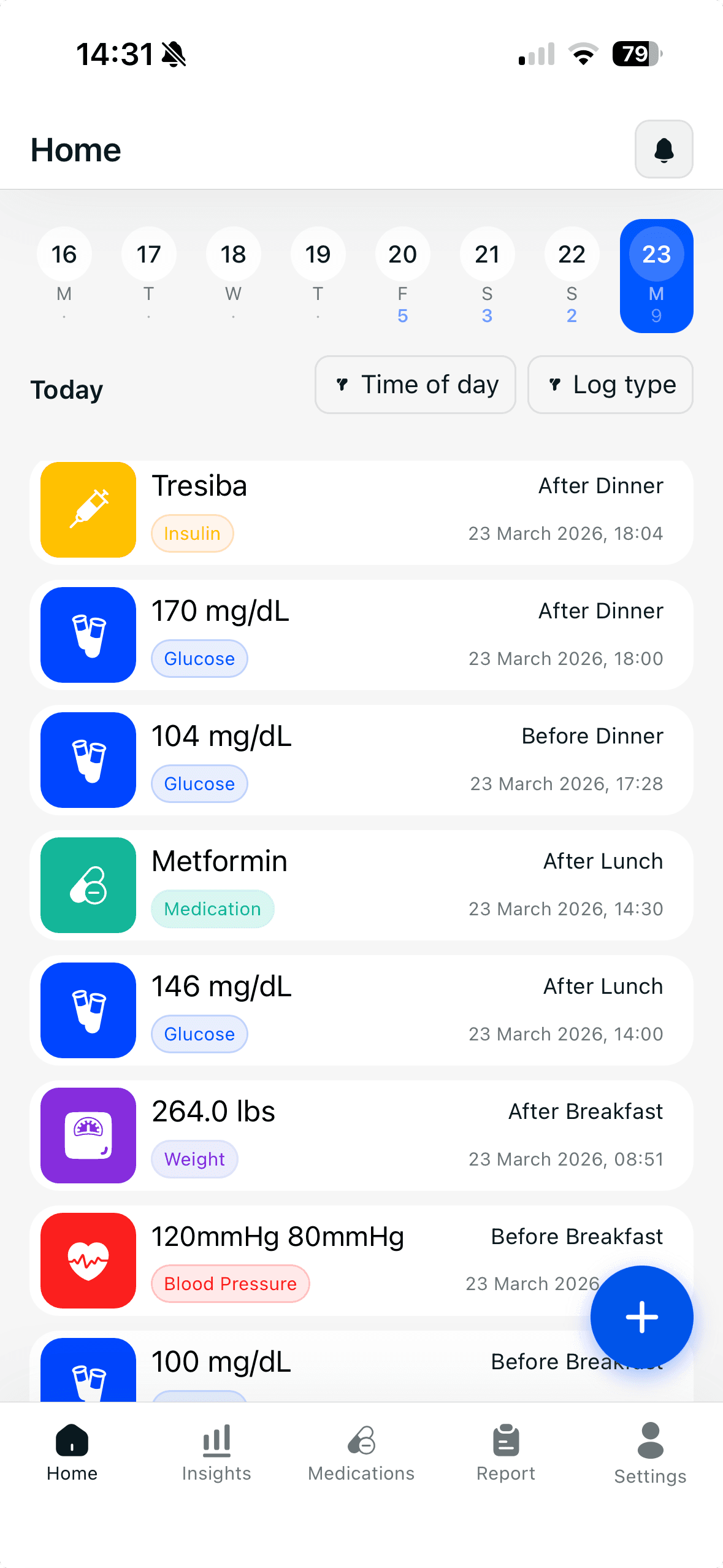
If you are pursuing remission, tracking both weight and blood sugar over time is essential. Glucoly lets you log weight, blood glucose, estimated A1C, blood pressure, and medications in one place. The 30-day and 90-day trend windows show whether your blood sugar is tracking downward as weight decreases, giving you objective evidence of progress to share with your doctor.
The doctor-ready PDF export in Glucoly lets you bring a complete record of weight trends alongside blood sugar data, making conversations with your care team more productive and data-driven.
This article is for general education and is not medical advice. Consult your healthcare provider before making changes to your treatment plan. Significant dietary interventions, particularly very low calorie programs, should be undertaken with medical supervision.
Frequently Asked Questions
Is type 2 diabetes remission permanent?
- Remission is not permanent by default. DiRECT data at 5 years showed approximately 13% of those who had achieved remission were still in remission, with weight regain being the primary driver of relapse.
- Maintaining weight loss is the key to sustaining remission. People who kept the weight off had the best long-term outcomes.
- Even partial weight regain can cause blood sugar to rise back above the diabetes threshold.
- Regular monitoring, including annual A1C tests and consistent weight tracking in Glucoly, helps detect early signs of relapse so action can be taken quickly.
How long does it take to see blood sugar improvement with weight loss?
- Blood sugar can begin to improve within days to weeks of starting a significant calorie restriction, even before substantial weight loss has occurred.
- In the DiRECT trial, many participants saw blood sugar improvements within the first 2-4 weeks of the low-calorie phase.
- A1C, which reflects average blood sugar over approximately 3 months, typically takes 3 months to show meaningful change after a dietary intervention.
- Logging your blood sugar daily in Glucoly, alongside your weight, lets you see short-term glucose improvements that the A1C test will not reflect for weeks or months.
Can type 1 diabetes go into remission with weight loss?
- No. Type 1 diabetes is an autoimmune condition in which the immune system destroys insulin-producing beta cells. Weight loss does not restore beta cell function in type 1 diabetes.
- Type 1 diabetes always requires insulin therapy. There is no lifestyle-based remission pathway.
- Some people with type 1 diabetes experience a 'honeymoon phase' shortly after diagnosis, where residual beta cells still produce some insulin. This is temporary and unrelated to weight loss.
- If you have type 1 diabetes, focus on consistent glucose monitoring, insulin dose optimization, and working closely with your endocrinologist.
Sources
- Lean ME, et al. Primary care-led weight management for remission of type 2 diabetes (DiRECT). Lancet. 2018.
- Riddle MC, et al. Consensus Report: Definition and Interpretation of Remission in Type 2 Diabetes. Diabetes Care. 2021.
- American Diabetes Association. Standards of Medical Care in Diabetes 2024. diabetes.org
Track your blood sugar and spot patterns with Glucoly - free on iOS and Android.
Download GlucolyShare this article
Related Posts
What Is LADA (Type 1.5 Diabetes)? Symptoms and How It Differs from Type 1 and Type 2
LADA (type 1.5 diabetes) is autoimmune diabetes that develops slowly in adults, often misdiagnosed as type 2.…
Read more →EducationDiabetic Retinopathy: How Diabetes Affects Your Eyes (and How to Protect Them)
Diabetic retinopathy is the leading cause of blindness in adults — largely preventable. Learn the stages, symp…
Read more →EducationWhat Is Diabetic Ketoacidosis (DKA)? Warning Signs You Must Know
DKA is a life-threatening diabetes emergency. Know the warning signs — fruity breath, vomiting, confusion — an…
Read more →