Carb counting for diabetes means tracking grams of carbohydrate per meal to predict and control blood sugar spikes. Here's how to start - and what to watch for.
Carb counting for diabetes is a meal-planning method where you track the grams of carbohydrate you eat at each meal to predict and manage blood sugar rises. Because carbohydrates break down into glucose more directly than protein or fat, knowing how many carbs you're eating gives you the clearest lever for keeping your readings in range. The American Diabetes Association recognizes carb counting as one of the most effective strategies for both Type 1 and Type 2 diabetes.
In this article
- What Is Carb Counting and Why Does It Matter?
- How Carbs Affect Blood Sugar: Fast vs Slow
- How to Read a Nutrition Label for Carbs
- Practical Carb Targets: What the ADA Recommends
- High-Carb Foods That Catch People Off Guard
- Estimating Carbs When Eating Out or Cooking at Home
- Tracking Glucose Alongside Carbs Reveals Your Personal Patterns
- How many carbs should a diabetic eat per day?
- Do I need to count carbs if I use insulin?
- What are net carbs?
- At a Glance: Carbohydrates raise blood sugar more than any other macronutrient.
- Total carbs on the nutrition label - not net carbs - is the number to count first.
- ADA guidelines suggest 45–60 g carbs per meal as a general starting point; your target may differ.
- Fast carbs (white bread, juice, sugary drinks) spike glucose quickly; slow carbs (legumes, whole grains) rise gradually.
- Tracking glucose before and after meals reveals how your body specifically responds to what you ate.
- Always confirm your personal carb targets with your healthcare provider.
What Is Carb Counting and Why Does It Matter?
When you eat carbohydrates, your digestive system converts them into glucose, which enters your bloodstream. In people without diabetes, insulin automatically keeps that rise in check. In diabetes, that system is impaired - so the amount of carbohydrate you eat has a direct, predictable effect on how high your blood sugar goes.
Carb counting gives you that predictability back. Instead of guessing, you work with a number. For people with Type 1 diabetes using insulin, the carb count is used to calculate the bolus dose. For people with Type 2 diabetes, it helps avoid the high-carb meals that overwhelm an already-stressed system.
- Carbohydrates raise blood glucose: roughly 1 gram of carbohydrate raises blood sugar approximately 3–5 mg/dL (0.17–0.28 mmol/L) in most adults, though this varies widely.
- Protein and fat have minimal direct glucose impact - they matter for satiety and overall health, but they won't spike your readings the way carbs do.
- Consistency matters: eating similar carb amounts at the same meals each day makes glucose patterns more predictable and easier to manage.
How Carbs Affect Blood Sugar: Fast vs Slow
Not all carbohydrates behave the same way. The glycemic index (GI) ranks foods by how quickly they raise blood sugar compared to pure glucose. High-GI foods digest rapidly and cause sharp spikes; low-GI foods digest more slowly and produce a gentler, more prolonged rise.
Blood sugar typically peaks 1–2 hours after eating. With a high-GI meal, that peak is steeper and faster. With a low-GI meal, the rise is slower and easier for your body - or your medication - to handle.
- High-GI (fast carbs): white bread, white rice, sugary drinks, fruit juice, most breakfast cereals, crackers.
- Medium-GI: whole-wheat bread, brown rice, bananas, sweet corn, oatmeal.
- Low-GI (slow carbs): legumes (lentils, chickpeas, kidney beans), most vegetables, most fruits, whole grain pasta, barley.
- Fiber, fat, and protein eaten alongside carbs slow digestion and blunt the glucose spike - a good reason to build balanced plates.
Glycemic index is a useful guide, but glycemic load (GI multiplied by the portion size) is even more practical. A food can be high-GI but low in actual carbs - watermelon, for example - so a small portion has little impact. Focus on total carbs in a realistic serving, not GI alone.
How to Read a Nutrition Label for Carbs
The nutrition facts panel is your main tool. Here's what each carb-related line means and which one to count.
- Total Carbohydrate: the number to start with. It includes all carbs in the serving - starches, sugars, and fiber.
- Dietary Fiber: a subset of total carbs that your body cannot fully digest. It slows glucose absorption and is beneficial.
- Total Sugars: includes naturally occurring sugars (in fruit, milk) plus added sugars - both are already counted in total carbs.
- Net Carbs (not on official US labels): a marketing term calculated as Total Carbs minus Fiber (and sometimes sugar alcohols). It can underestimate impact in some people.
- Serving Size: always check this first. If you eat twice the serving, you double every number on the label.
For most people with diabetes, the American Diabetes Association recommends counting total carbohydrates rather than net carbs, because the fiber subtraction can be misleading, especially with processed foods that use fiber-isolate ingredients. Talk to your dietitian about which approach works best for you.
Practical Carb Targets: What the ADA Recommends
There is no universal carb target for diabetes - it depends on your weight, activity level, medications, and glucose goals. That said, the American Diabetes Association provides ranges that are a useful starting point.
- General ADA starting range: 45–60 grams of carbohydrate per meal for many adults, or roughly 135–180 g per day.
- Lower-carb approaches: some clinical guidelines support 20–45 g per meal for better post-meal control, especially in Type 2 diabetes - always discuss with your care team first.
- Type 1 diabetes: carb targets are often used alongside an insulin-to-carb ratio (e.g., 1 unit of insulin per 10–15 g carbs) set by your endocrinologist.
- Type 2 diabetes: reducing total daily carbs - rather than precise counting - is sometimes the first step, particularly if using oral medications.
- Snacks: if you snack, a common range is 15–30 g per snack, depending on your daily target.
Consult your healthcare provider before making changes to your treatment plan. These ranges are guidelines, not prescriptions - your individual target should be set by your care team based on your specific situation.
High-Carb Foods That Catch People Off Guard
Some foods carry far more carbohydrates than most people expect. These are common surprises for people who are new to carb counting.
- Fruit juice: a 250 ml (8 oz) glass of orange juice contains about 26 g of carbs - the same as a slice of white bread - with none of the fiber of a whole orange.
- White rice: a standard restaurant portion (1.5 cups cooked) can easily contain 60–70 g of carbs.
- Bagels: a large bagel is often 55–65 g of carbs - not 30 g like a standard slice of bread.
- Flavored yogurt: many single-serve fruit-on-the-bottom yogurts contain 25–40 g of carbs per cup, most from added sugar.
- Smoothies and blended drinks: can pack 50–80 g of carbs depending on fruit and added sweeteners.
- Potatoes: a medium baked potato is about 35–40 g of carbs; fries or mashed potatoes often more.
- Sports drinks: designed to replenish glycogen rapidly - a 500 ml bottle is typically 30–35 g of fast-digesting carbs.
Estimating Carbs When Eating Out or Cooking at Home
Nutrition labels help at home, but eating out and home cooking require estimation. These strategies make that easier.
- Use reference portions: 1/3 cup cooked rice or pasta ≈ 15 g carbs; 1 slice of bread ≈ 15 g carbs; 1 small piece of fruit ≈ 15 g carbs. These 15 g 'carb servings' are the standard unit in ADA meal planning.
- Use a food database app to look up restaurant dishes before ordering - many chain restaurants publish full nutrition data.
- At restaurants: plates typically arrive with 2–3× the standard portion. Estimate by size (a fist of cooked rice ≈ 1/2 cup ≈ 30 g) or ask for the nutrition info.
- At home: invest in a kitchen scale for the first few weeks. Measuring builds a reliable mental library of what portions actually look like.
- Ask your diabetes care team or a registered dietitian for a personalized carb-counting guide - many provide visual portion cards.
Tracking Glucose Alongside Carbs Reveals Your Personal Patterns
Carb counting tells you what went in. Blood glucose tracking tells you what happened as a result. Together, they reveal something no general guideline can: your personal response to specific foods.
Because individual glucose responses vary significantly - even to identical meals - the only way to know how your body handles a particular food is to check before eating and again 1–2 hours after. Over time, you'll see which meals keep you comfortably in range and which push you higher than expected.
- Log your pre-meal glucose and the estimated carb count, then check again 1–2 hours post-meal.
- Look for patterns over 7–14 days: which meals consistently spike you? Which keep you steady?
- Share the data with your care team - patterns from real meals are far more useful than guesses.
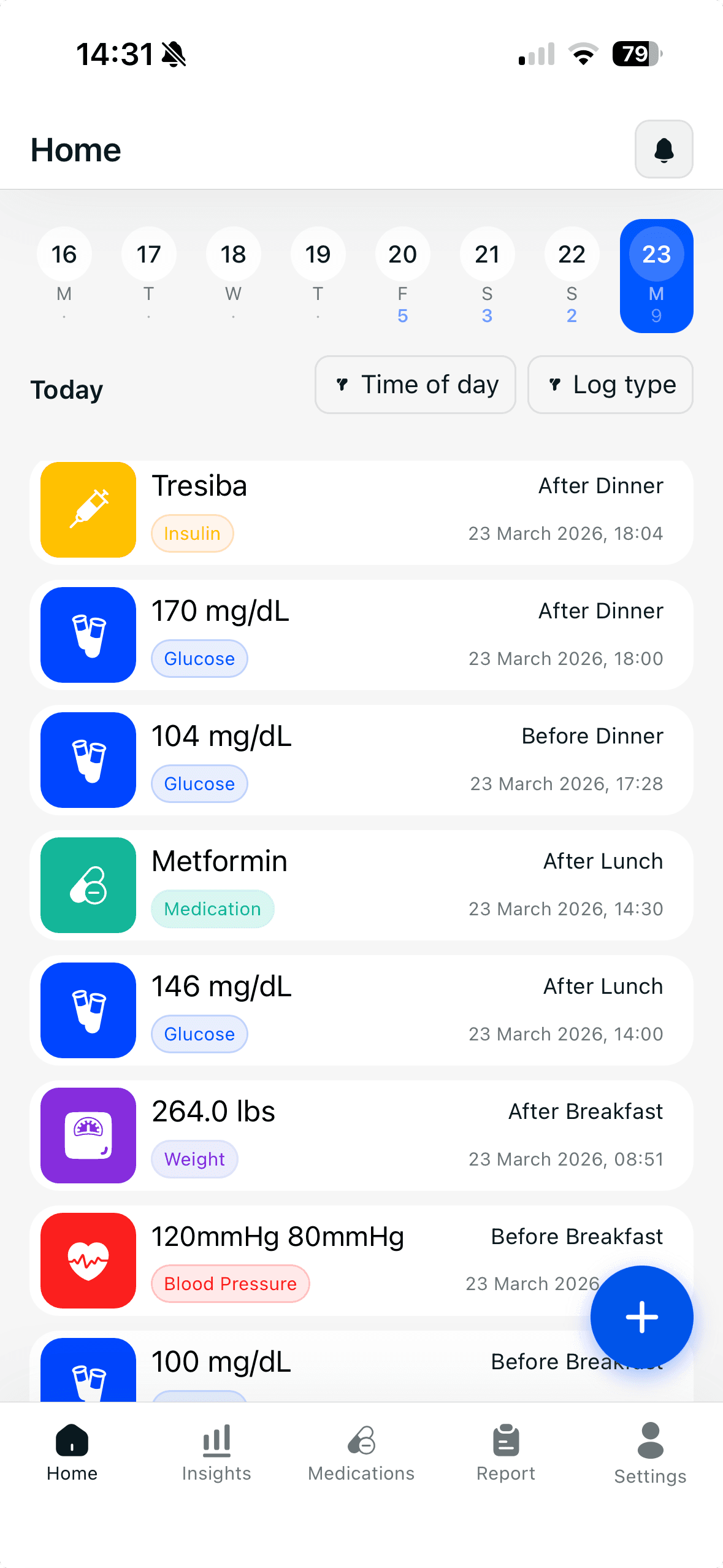
Glucoly makes this pairing natural. You can tag readings as before-meal or after-meal, view glucose trends across 7, 14, 30, and 90-day windows, and export a doctor-ready PDF report - so the patterns you spot don't stay in your head, they travel to your next appointment.
This article is for general education and is not medical advice. Consult your healthcare provider before making changes to your treatment plan.
Frequently Asked Questions
How many carbs should a diabetic eat per day?
- There is no single correct answer - it depends on your type of diabetes, medications, weight, activity level, and glucose goals.
- A common ADA starting point is 45–60 g of carbs per meal (135–180 g per day), but lower-carb approaches (20–45 g per meal) have strong clinical evidence for blood sugar control, especially in Type 2 diabetes.
- Work with your healthcare provider or a registered dietitian to set a target that fits your specific treatment plan.
Do I need to count carbs if I use insulin?
- Yes - and it becomes even more important. Most people with Type 1 diabetes use an insulin-to-carb ratio, meaning the carb count directly determines how much bolus insulin to take.
- Even with fixed insulin doses, knowing your carb intake helps you recognize why your glucose is higher or lower than expected after a meal.
- Your endocrinologist or diabetes educator sets your ratio; accurate carb counting makes that ratio work.
What are net carbs?
- Net carbs = Total Carbohydrates minus Dietary Fiber (and sometimes sugar alcohols). The idea is that fiber is not fully digested and therefore doesn't raise blood sugar.
- Net carbs is a marketing term - it does not appear on official nutrition labels in the US.
- The ADA recommends counting total carbohydrates for most people with diabetes, because net carb calculations can underestimate the glucose impact of certain processed foods.
- If you want to experiment with net carb counting, discuss it with your dietitian first.
Sources
- American Diabetes Association. Understanding Carbohydrates. diabetes.org/food-nutrition/understanding-carbs
- American Diabetes Association. Standards of Medical Care in Diabetes 2024. diabetes.org
- Centers for Disease Control and Prevention. Healthy Eating with Diabetes. cdc.gov/diabetes/healthy-eating
Start pairing your carb counts with your glucose readings in Glucoly - free on the App Store and Google Play.
Download GlucolyShare this article
Related Posts
What Is LADA (Type 1.5 Diabetes)? Symptoms and How It Differs from Type 1 and Type 2
LADA (type 1.5 diabetes) is autoimmune diabetes that develops slowly in adults, often misdiagnosed as type 2.…
Read more →EducationDiabetic Retinopathy: How Diabetes Affects Your Eyes (and How to Protect Them)
Diabetic retinopathy is the leading cause of blindness in adults — largely preventable. Learn the stages, symp…
Read more →EducationWhat Is Diabetic Ketoacidosis (DKA)? Warning Signs You Must Know
DKA is a life-threatening diabetes emergency. Know the warning signs — fruity breath, vomiting, confusion — an…
Read more →