Time in Range measures the percentage of the day your glucose stays between 70 and 180 mg/dL. Here is how TIR works, why it complements A1C, and how to improve it.
For decades, A1C was the single number that defined diabetes control. It still matters — but it only tells you your average glucose over two to three months, and averages hide a lot. Two people can share the same A1C while one rides a rollercoaster of highs and lows and the other stays steady. Time in Range (TIR) fills that gap by showing how much of each day your glucose actually spends in a healthy zone. With continuous glucose monitors (CGMs) now widespread, TIR has become one of the most useful day-to-day metrics in diabetes care.
In this article
What Time in Range Actually Measures
Time in Range is the percentage of a 24-hour day that your glucose stays within a target window. For most adults with type 1 or type 2 diabetes, that window is 70 to 180 mg/dL (3.9 to 10.0 mmol/L). If your glucose sits inside that band for 17 out of 24 hours, your TIR is roughly 70 percent. Alongside TIR, a CGM report breaks the rest of the day into Time Above Range (TAR) and Time Below Range (TBR), so you can see whether your out-of-range hours are highs, lows, or both.
The Standard TIR Targets
International consensus guidelines set clear goals for most non-pregnant adults with diabetes. These are starting points — your care team may personalize them, and older adults or those at high risk of hypoglycemia are often given more relaxed targets to prioritize safety.
- Time in Range (70–180 mg/dL / 3.9–10.0 mmol/L): aim for more than 70 percent of the day — about 17 hours
- Time Above Range (above 180 mg/dL / 10.0 mmol/L): keep under 25 percent
- Time in serious high range (above 250 mg/dL / 13.9 mmol/L): keep under 5 percent
- Time Below Range (below 70 mg/dL / 3.9 mmol/L): keep under 4 percent
- Time in serious low range (below 54 mg/dL / 3.0 mmol/L): keep under 1 percent
TIR vs A1C: Why Both Matter
A1C and TIR are related but not interchangeable. Research shows that each 10 percent increase in Time in Range corresponds to an A1C reduction of roughly 0.5 to 0.8 percent, and a TIR of about 70 percent lines up with an A1C near 7 percent. But A1C can be misleading in people with anemia, kidney disease, or conditions that change red blood cell lifespan, and it says nothing about glucose swings. TIR captures the variability and the lows that A1C completely misses — which is exactly what drives daily symptoms and long-term complication risk. The two work best together: A1C for the long-term trend your doctor tracks, TIR for the daily patterns you can act on.
What Affects Your Time in Range
TIR is sensitive to the same factors that shape any glucose reading, but because it is measured continuously, it reveals patterns a few fingersticks would miss.
- Meal composition — large or fast-digesting carbohydrate loads push you above 180 mg/dL (10.0 mmol/L) for longer
- Medication timing — a rapid-acting insulin dose taken 15 minutes before eating covers a meal spike far better than one taken at the first bite
- Physical activity — a short walk after meals is one of the most reliable ways to shorten post-meal highs
- Sleep and stress — poor sleep and elevated cortisol raise glucose overnight, eating into your range while you rest
- Overtreating lows — chasing a 65 mg/dL (3.6 mmol/L) reading with too much sugar creates a rebound high, costing range on both ends
Practical Ways to Improve TIR
Small, repeatable changes move TIR more than dramatic overhauls. Because TIR responds within days, you get fast feedback on whether an adjustment is working.
- Focus on the biggest offender first — if most of your out-of-range time is after dinner, target that meal before anything else
- Pre-bolus insulin (if you use it) and pair carbohydrates with protein, fat, or fiber to blunt spikes
- Add a 10 to 15 minute walk after your largest meal of the day
- Treat lows with a measured 15 grams of fast carbs, wait 15 minutes, then recheck — the classic 15-15 rule prevents overcorrection
- Review your CGM's daily overlay weekly to spot the recurring times you drift out of range
Do You Need a CGM to Track TIR?
True Time in Range is calculated from continuous readings, so a CGM such as a Dexcom or FreeStyle Libre sensor gives the most accurate picture. If you use fingersticks, you cannot get a precise TIR percentage, but you can still track how often your readings land inside 70 to 180 mg/dL (3.9 to 10.0 mmol/L) as a useful proxy. Either way, the value comes from reviewing the pattern over time rather than reacting to any single number.
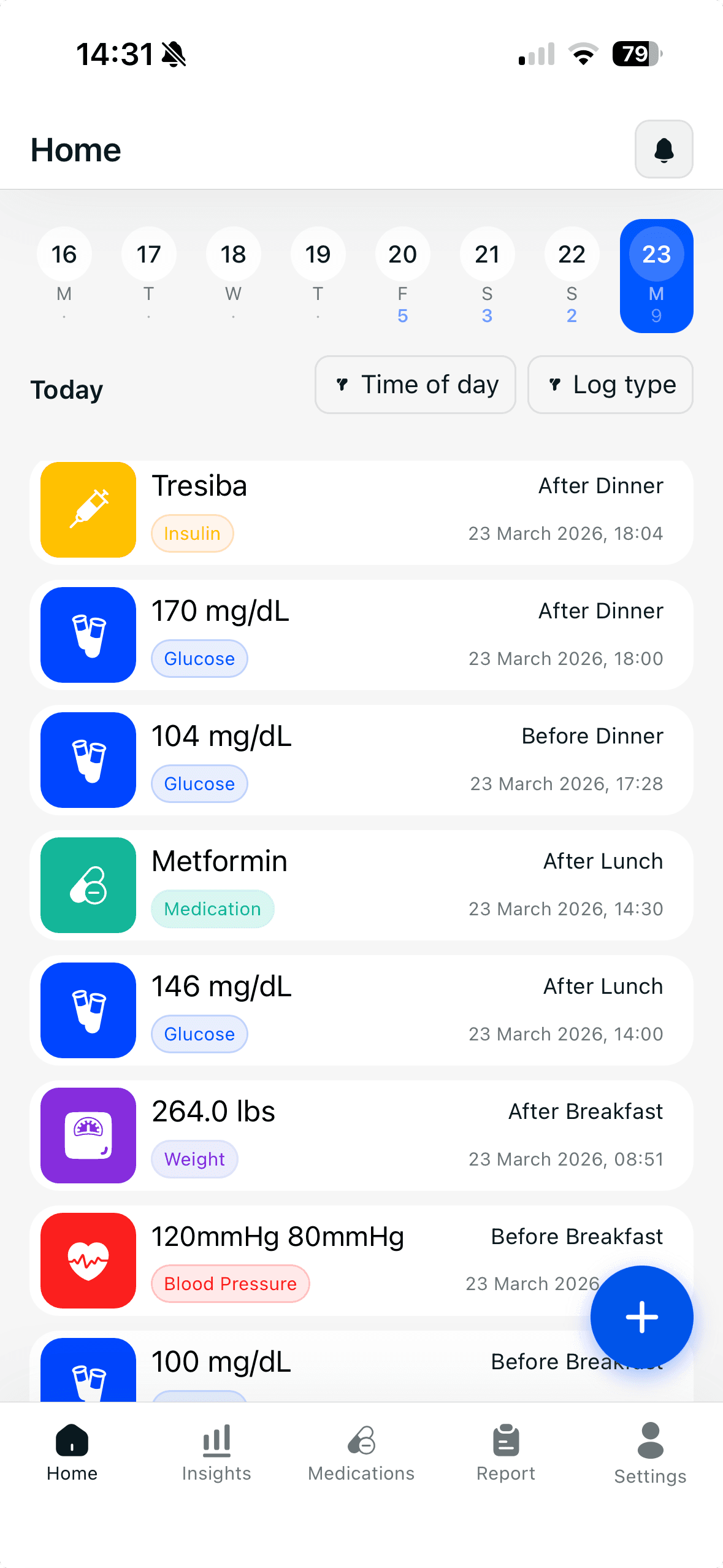
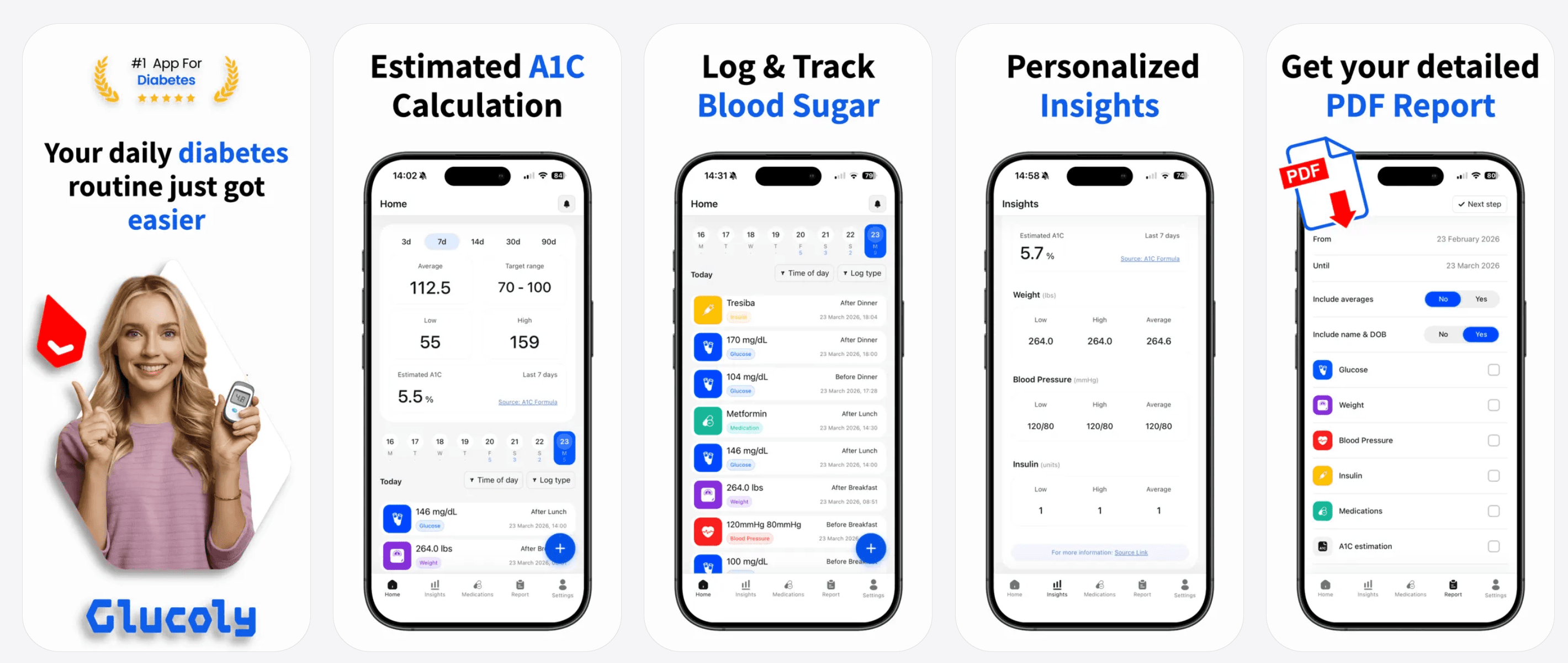
Glucoly brings your Time in Range data together in one place: sync Dexcom and FreeStyle Libre readings automatically through Apple Health, or log fingersticks by hand — the hybrid approach is yours to choose. Download Glucoly free on the App Store and Google Play to log glucose and every other metric at no cost, and unlock estimated A1C and detailed trend reports with Glucoly Premium.
Download GlucolySources
- Battelino T, et al. Clinical Targets for Continuous Glucose Monitoring Data Interpretation: Recommendations From the International Consensus on Time in Range. Diabetes Care. 2019;42(8):1593-1603.
- American Diabetes Association. Standards of Care in Diabetes 2024. Diabetes Care 2024;47(Suppl 1).
- Beck RW, et al. Validation of Time in Range as an Outcome Measure for Diabetes Clinical Trials. Diabetes Care. 2019;42(3):400-405.
Share this article
Related Posts
What Is LADA (Type 1.5 Diabetes)? Symptoms and How It Differs from Type 1 and Type 2
LADA (type 1.5 diabetes) is autoimmune diabetes that develops slowly in adults, often misdiagnosed as type 2.…
Read more →EducationDiabetic Retinopathy: How Diabetes Affects Your Eyes (and How to Protect Them)
Diabetic retinopathy is the leading cause of blindness in adults — largely preventable. Learn the stages, symp…
Read more →EducationWhat Is Diabetic Ketoacidosis (DKA)? Warning Signs You Must Know
DKA is a life-threatening diabetes emergency. Know the warning signs — fruity breath, vomiting, confusion — an…
Read more →