Carb counting helps you manage blood sugar by tracking grams of carbs per meal. This beginner guide covers how to read labels, set targets, and start.
Carb counting means tracking the grams of carbohydrates in everything you eat, because carbohydrates have the greatest impact on blood sugar of any macronutrient. Each gram of carbohydrate raises blood sugar by approximately 3–4 mg/dL in most adults. People with diabetes use carb counts to adjust insulin doses (insulin-to-carb ratio) or to stay within a daily carb budget that keeps blood sugar in target range.
In this article
- Why Carbohydrates Affect Blood Sugar More Than Anything Else
- Step 1: Learn to Read a Nutrition Label
- Step 2: Learn Portion Sizes for Common Foods
- Step 3: Set Your Daily Carb Target
- The Insulin-to-Carb Ratio (for Insulin Users)
- Carb Counting Tools That Help
- Common Carb Counting Mistakes to Avoid
- How many carbs should a diabetic eat per day?
- What are net carbs and should I count them?
- Does carb counting work for type 2 diabetes without insulin?
At a Glance
- Carbohydrates — not fat or protein — have the biggest impact on blood sugar after eating
- 1 gram of carbohydrate raises blood sugar by approximately 3–4 mg/dL in most adults (varies significantly by person)
- A common starting target for type 2 diabetes is 45–60g carbs per meal and 15–30g per snack (ADA)
- For type 1 diabetes, the insulin-to-carb ratio determines the bolus dose: e.g. 1 unit per 10g carbs
- All carbs count: sugars, starches, and fibre (fibre is usually subtracted from total carbs to get “net carbs”)
- Food labels, apps, and portion measuring tools make carb counting accurate and manageable
Why Carbohydrates Affect Blood Sugar More Than Anything Else
When you eat carbohydrates, your digestive system breaks them down into glucose, which passes into your bloodstream and raises blood sugar. This process happens faster or slower depending on the type of carbohydrate, but unlike fat and protein, virtually all of the carbohydrate you eat becomes blood glucose within a few hours. That is why carbohydrate intake is the primary variable that people with diabetes track to manage their blood sugar levels.
- Carbohydrates are broken down into glucose during digestion — this is the primary source of blood glucose
- Simple carbs (white bread, sugar, juice) digest rapidly, causing fast steep blood sugar spikes within 30–60 minutes
- Complex carbs (whole grains, legumes, vegetables) digest slowly, causing a more gradual, lower rise
- Fat and protein raise blood sugar minimally and much more slowly than carbohydrates
- Total carbohydrate grams — not sugar grams alone — determine the blood sugar impact of a meal
- Fibre slows carbohydrate absorption and reduces post-meal glucose peaks
Step 1: Learn to Read a Nutrition Label
- Find “Total Carbohydrate” on the label — this is the number to use, not just “Sugars”
- The carb count shown is per serving — check the serving size carefully (e.g. one portion may be half a bag)
- Dietary fibre: some people subtract fibre from total carbs to calculate “net carbs” — because fibre is not absorbed
- Sugar alcohols (e.g. xylitol, sorbitol, erythritol): count approximately half their grams toward blood sugar impact
- Added sugars: listed separately for awareness but already included in the Total Carbohydrate number
- Practice: read labels on 5 foods you eat regularly this week to start building intuition for portion sizes
Step 2: Learn Portion Sizes for Common Foods
Knowing the carbohydrate content of individual foods is only useful when combined with an accurate understanding of portion sizes. Portions in restaurants, packaged foods, and home cooking often differ significantly from standard reference sizes. The list below shows common reference portions to help you build a mental library of carb counts.
- 1 slice of bread: approximately 15g carbs
- Half a cup of cooked pasta, rice, or potato: approximately 15–20g carbs
- 1 medium banana: approximately 27g carbs
- 1 medium apple: approximately 25g carbs
- Half a cup of cooked lentils or beans: approximately 20g carbs
- 1 cup of milk: approximately 12g carbs
- 1 cup of non-starchy vegetables (broccoli, spinach, cucumber): approximately 5g carbs
- 1 tablespoon of sugar: approximately 13g carbs
Step 3: Set Your Daily Carb Target
There is no single carb target that suits everyone with diabetes. Your optimal intake depends on your diabetes type, the medications you take, your weight goals, your activity level, and how your blood sugar responds to specific foods. The ranges below are starting points used in clinical guidelines — treat them as a foundation to refine with your diabetes care team, not as fixed rules.
- Type 2 diabetes (general guidance): 45–60g carbs per meal, 15–30g per snack — this is a starting point, not a fixed rule
- Type 1 diabetes: carb target is less fixed — bolus insulin is adjusted per meal using the insulin-to-carb (I:C) ratio
- Low-carb approach (under 130g/day): can reduce A1C and medication needs significantly — discuss with your doctor if you take insulin or sulfonylureas, as dose adjustments will be needed
- Very low-carb/keto (under 50g/day): may produce rapid blood sugar improvement but carries hypoglycemia risk with glucose-lowering medications
- Work with a registered dietitian to set a target based on your medication, blood sugar patterns, and lifestyle
The Insulin-to-Carb Ratio (for Insulin Users)
For people who use rapid-acting insulin at mealtimes — including most people with type 1 diabetes and some with type 2 — carb counting is not just about staying within a budget. It is the input for a calculation that determines exactly how much insulin to inject. This calculation is driven by the insulin-to-carb (I:C) ratio, which is set by your diabetes care team based on your individual insulin sensitivity.
- The I:C ratio tells you how many grams of carbohydrate 1 unit of rapid-acting insulin covers
- Example: an I:C ratio of 1:10 means 1 unit of insulin covers 10g of carbohydrates
- To calculate your mealtime bolus: divide the carbs in your meal by your I:C ratio. E.g. 60g carbs ÷ 10 = 6 units
- I:C ratios are set by your diabetes care team and may differ at different times of day
- Do not adjust your I:C ratio without guidance — errors can cause dangerous hypoglycemia or hyperglycemia
- CGMs make it easier to see whether your I:C ratio is accurate by showing the blood sugar curve after meals
Carb Counting Tools That Help
- Food labels: the most accurate source for packaged foods
- Kitchen scale: weighing food in grams is significantly more accurate than eyeballing portion sizes
- Measuring cups and spoons: useful for common portions like cereal, rice, and pasta
- Carb counting apps: many apps have large food databases that provide carb counts for restaurant meals and whole foods
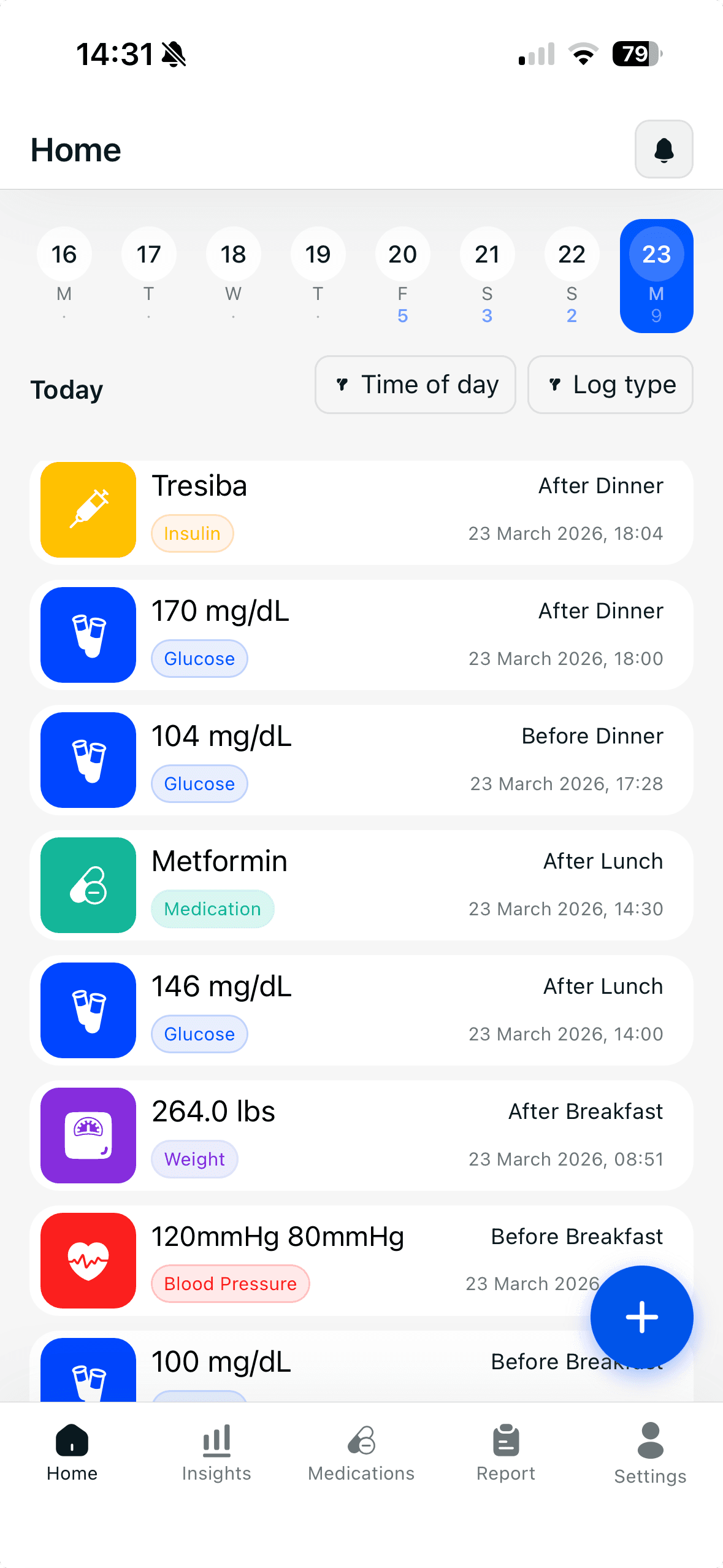
- Glucoly: log your meals alongside your blood sugar readings to see exactly how specific foods affect your glucose levels
- Restaurant menus: most major chains publish nutritional information online — search before you eat out
Common Carb Counting Mistakes to Avoid
- Only counting sugar, not total carbs: the starch in bread or potato raises blood sugar just as much as sugar
- Forgetting drinks: juice, milk, sports drinks, and even lattes contain significant carbs
- Underestimating portion size: the carbs in a restaurant meal are often 2–3 times larger than a standard home portion
- Ignoring sauces and condiments: ketchup, sweet chilli sauce, and teriyaki contain significant sugar
- Not accounting for combination dishes (soups, stews, pizza): estimate each component or look up the whole dish
- Treating “sugar-free” as “carb-free”: sugar-free products still contain starches and carbohydrates
Frequently Asked Questions
How many carbs should a diabetic eat per day?
There is no universal answer — carb needs vary based on diabetes type, medication, weight goals, activity level, and individual blood sugar response. A common starting point for type 2 diabetes is 130–195g per day (45–65g per meal). Many people find lower-carb approaches (under 100g/day) produce better blood sugar control. Work with your diabetes team to find your personal optimal range.
What are net carbs and should I count them?
Net carbs = total carbohydrates minus dietary fibre. Fibre is subtracted because it is not digested and absorbed as glucose. Net carbs is most useful for people following low-carb or ketogenic diets. For people counting carbs at 45–60g per meal, using total carbs (as listed on the label) is simpler and safer. Net carbs calculations become more complex with sugar alcohols, which vary in their blood sugar impact.
Does carb counting work for type 2 diabetes without insulin?
Yes. Carb counting is effective for managing post-meal blood sugar even without insulin. Knowing how many carbs are in each meal helps you make choices that keep readings within target range. Paired with a glucose monitor (or CGM), you can identify which specific foods and portion sizes cause problematic spikes — and adjust accordingly.
Pair carb counting with real data: log meals and glucose in Glucoly — free to download, manual or Apple Health/Dexcom sync, with Glucoly Premium for estimated A1C and detailed reports.
Download GlucolySources
- American Diabetes Association (ADA) — diabetes.org
- Diabetes UK — diabetes.org.uk
- National Institute of Diabetes and Digestive and Kidney Diseases (NIDDK) — niddk.nih.gov
- Academy of Nutrition and Dietetics — eatright.org
Share this article
Related Posts
How Protein Affects Blood Sugar Levels in Diabetes
Protein raises blood sugar slowly and much less than carbs. Learn how gluconeogenesis works, best protein sour…
Read more →NutritionIntermittent Fasting for Type 2 Diabetes: Does It Work?
Intermittent fasting can lower A1C and blood sugar in type 2 diabetes — but carries hypoglycemia risk with ins…
Read more →Nutrition7-Day Diabetes Meal Plan for Beginners (With Grocery List)
A simple 7-day diabetes meal plan with breakfast, lunch, dinner, snacks, and a full grocery list. Designed for…
Read more →