Learn what the insulin correction factor (ISF) is, how to calculate it using the 1800 Rule, and how to use it safely to bring high blood sugar back to target.
The insulin correction factor (also called the insulin sensitivity factor, or ISF) tells you how many mg/dL - or mmol/L - one unit of rapid-acting insulin will lower your blood sugar. If your correction factor is 45 mg/dL (2.5 mmol/L), one unit drops your glucose by that amount over roughly 2–3 hours. Knowing your correction factor is essential for safely bringing a high glucose reading back to target without triggering hypoglycemia.
In this article
- Why Your Correction Factor Matters
- How to Calculate Your Correction Factor: The 1800 Rule
- The 1800 Rule vs the 1500 Rule
- Step-by-Step: How to Calculate Your Correction Factor
- Insulin-to-Carb Ratio Alongside the Correction Factor
- Why Your Correction Factor Changes
- How to Verify Your Correction Factor
- Tracking Correction Boluses in Glucoly
- What is a normal insulin correction factor?
- How do I know if my correction factor is right?
- What is the difference between correction factor and carb ratio?
- At a Glance: The correction factor (CF) tells you how much 1 unit of insulin lowers your blood sugar (mg/dL or mmol/L per unit).
- Calculate using the 1800 Rule for rapid-acting insulin: CF = 1800 ÷ Total Daily Dose (TDD) in mg/dL. Use 100 ÷ TDD for mmol/L.
- Example: TDD of 40 units → CF = 1800 ÷ 40 = 45 mg/dL (2.5 mmol/L) per unit.
- CF differs from the insulin-to-carb ratio (ICR), which tells you how many grams of carbs 1 unit covers.
- CF changes with time of day, illness, exercise, stress, and hormones - it is not a fixed number.
- Always establish your CF in partnership with your endocrinologist - never adjust insulin doses alone.
Why Your Correction Factor Matters
Without knowing your correction factor, you have no reliable way to calculate a correction bolus - the extra insulin dose used to bring a high blood sugar reading back to your target range. Guessing leads to either under-correction (staying high too long, raising your A1C) or over-correction (causing hypoglycemia, sometimes severely). The correction factor turns a glucose reading into a specific, actionable number.
How to Calculate Your Correction Factor: The 1800 Rule
The most widely used formula for rapid-acting insulin (lispro, aspart, glulisine) is the 1800 Rule. Your Total Daily Dose (TDD) is the sum of all basal insulin plus all bolus insulin you take in an average 24-hour period.
- CF (mg/dL per unit) = 1800 ÷ Total Daily Dose
- CF (mmol/L per unit) = 100 ÷ Total Daily Dose
- Example: TDD = 40 units → CF = 1800 ÷ 40 = 45 mg/dL per unit (2.5 mmol/L per unit)
- Example: TDD = 60 units → CF = 1800 ÷ 60 = 30 mg/dL per unit (1.7 mmol/L per unit)
- Example: TDD = 25 units → CF = 1800 ÷ 25 = 72 mg/dL per unit (4.0 mmol/L per unit)
- For regular (short-acting) insulin, the 1500 Rule is used instead: CF = 1500 ÷ TDD.
The 1800 Rule vs the 1500 Rule
The 1800 Rule is designed for rapid-acting insulin analogues such as Humalog (lispro), NovoLog (aspart), and Apidra (glulisine). It divides 1800 by your Total Daily Dose (TDD) to estimate how many mg/dL one unit will drop your blood sugar. The 1500 Rule serves the same purpose but applies to Regular (short-acting) insulin — it divides 1500 by TDD because Regular insulin is slightly less potent per unit. As a practical example: if your TDD is 50 units, the 1800 Rule gives 1800 ÷ 50 = 36, meaning one unit of rapid-acting insulin lowers your blood sugar by approximately 36 mg/dL. Using the 1500 Rule with the same TDD gives 1500 ÷ 50 = 30 mg/dL per unit. Always confirm which insulin type you use before choosing a formula, and verify the result with your diabetes care team.
Step-by-Step: How to Calculate Your Correction Factor
- Add up all your insulin for the day (basal + all bolus doses) to find your Total Daily Dose (TDD)
- Choose your formula: 1800 ÷ TDD for rapid-acting insulin, or 1500 ÷ TDD for Regular insulin
- The result is your Insulin Sensitivity Factor (ISF) — how many mg/dL one unit lowers your blood sugar
- Example: TDD of 40 units → 1800 ÷ 40 = 45, so 1 unit drops glucose by ~45 mg/dL
- Verify with your diabetes care team before adjusting doses
Insulin-to-Carb Ratio Alongside the Correction Factor
The correction factor and the insulin-to-carb ratio (ICR) are the two core calculations in basal-bolus therapy. They answer different questions: the CF corrects existing highs; the ICR doses for upcoming meals.
- Correction factor (CF): how much does 1 unit of insulin lower my blood sugar? Used to correct existing highs.
- Insulin-to-carb ratio (ICR): how many grams of carbohydrates does 1 unit of insulin cover? Used to dose for meals.
- ICR is calculated using the 500 Rule: ICR = 500 ÷ TDD.
- Example: TDD = 40 units → ICR = 500 ÷ 40 = 12.5 → 1 unit covers approximately 12–13g of carbohydrates.
- Note: Glucoly does not include a bolus calculator. These formulas are for educational understanding - always work with your endocrinologist.
Why Your Correction Factor Changes
The 1800 Rule gives you a starting estimate, not a permanent truth. Many factors shift insulin sensitivity - and therefore your CF - from day to day and even hour to hour.
- Time of day: most people are more insulin resistant in the early morning (the dawn phenomenon) and more sensitive in the afternoon.
- Exercise: activity increases muscle glucose uptake and improves insulin sensitivity for 24–48 hours after exercise.
- Illness: infection and inflammation cause significant insulin resistance - correction doses may need to increase considerably.
- Stress: cortisol and adrenaline raise blood sugar and blunt insulin action.
- Hormonal cycles: insulin requirements often increase in the luteal phase (days before menstruation) for people who menstruate.
- Weight changes: gaining or losing significant weight changes TDD and therefore CF.
How to Verify Your Correction Factor
The 1800 Rule is a calculation tool - but real-world verification is essential. The classic method: choose a time when your blood sugar is stable and above target (not after a meal, not after exercise, not after a recent bolus). Take a correction dose based on your calculated CF. Do not eat or exercise for 2–3 hours. Recheck your blood sugar.
- If your blood sugar landed within 20–30 mg/dL (1.1–1.7 mmol/L) of your target, your CF is approximately correct.
- If you consistently over-correct (go low after corrections), your CF is too aggressive - increase the CF number.
- If you consistently under-correct (stay high after corrections), your CF is too conservative - decrease the CF number.
- Discuss all adjustments with your care team before changing your CF.
Tracking Correction Boluses in Glucoly
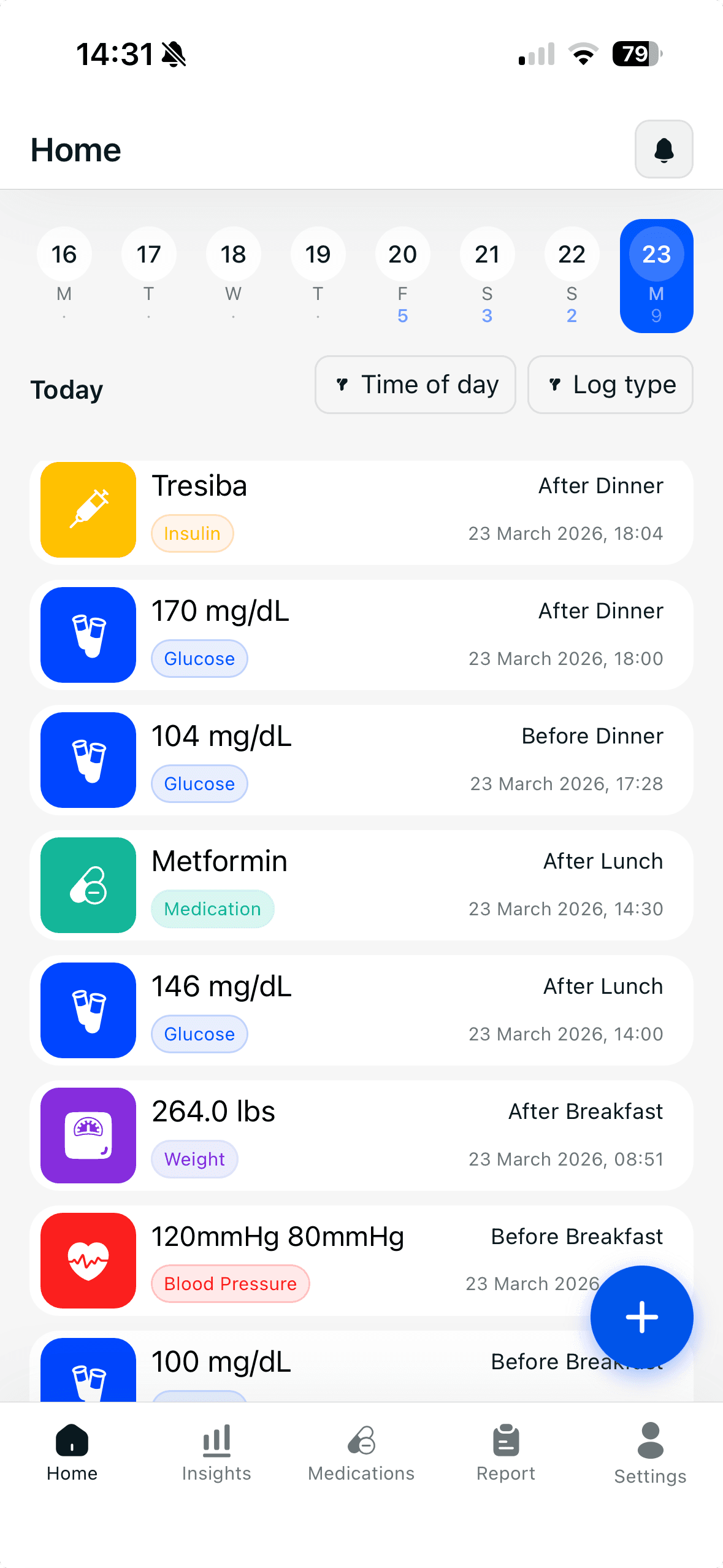
Glucoly's insulin logging feature lets you record every bolus dose alongside corresponding glucose readings. By logging your pre-correction blood sugar, your correction dose, and your post-correction reading 2–3 hours later, you build a personal dataset of how your CF performs in real life - not just in theory.
Over weeks, patterns emerge: your CF may be accurate in the afternoon but too aggressive in the early morning when the dawn phenomenon increases insulin resistance. This time-of-day pattern is exactly what an endocrinologist needs to individualize your correction factor by time block.
This article is for general education only. Insulin dosing calculations carry significant safety implications. Consult your healthcare provider before making changes to your treatment plan. Never adjust your insulin dose based on formulas alone without provider guidance.
Frequently Asked Questions
What is a normal insulin correction factor?
- There is no single 'normal' CF - it varies widely by individual. A CF of 30–50 mg/dL per unit (1.7–2.8 mmol/L per unit) is common for many adults with Type 1 diabetes.
- More insulin-sensitive people (leaner, more active, or earlier in their diabetes) may have a higher CF - for example, 70–90 mg/dL per unit.
- More insulin-resistant people (larger TDD, Type 2 with insulin, or significant insulin resistance) will have lower CFs - sometimes 15–25 mg/dL per unit.
- Your CF is personal - use the 1800 Rule as a starting point and verify with your care team.
How do I know if my correction factor is right?
- Test it: take a correction bolus under controlled conditions (stable BG, no recent food or exercise), wait 2–3 hours, and check if you landed near your target.
- If you consistently overshoot (go low after corrections), your CF is too aggressive - you need a higher number.
- If you consistently undershoot (stay high after corrections), your CF is too conservative - you need a lower number.
- Log correction boluses and post-correction readings in Glucoly to build a clear picture of your CF accuracy over time.
What is the difference between correction factor and carb ratio?
- Correction factor (CF): how much 1 unit of insulin drops your blood sugar. Used for correcting existing highs when not eating.
- Insulin-to-carb ratio (ICR): how many grams of carbohydrates 1 unit of insulin covers. Used for dosing at mealtimes.
- Both are calculated from your Total Daily Dose - CF uses the 1800 Rule, ICR uses the 500 Rule.
- In a full manual bolus calculation, both are used together: correction component + meal component = total bolus.
Sources
- American Diabetes Association. Standards of Medical Care in Diabetes 2024. diabetes.org
- Centers for Disease Control and Prevention. Insulin Therapy. cdc.gov/diabetes/treatment
Logging your insulin doses and glucose readings in Glucoly helps you and your care team see how your correction factor performs in real life - across times of day, activities, and conditions. Free on the App Store and Google Play.
Download GlucolyShare this article
Related Posts
What Is LADA (Type 1.5 Diabetes)? Symptoms and How It Differs from Type 1 and Type 2
LADA (type 1.5 diabetes) is autoimmune diabetes that develops slowly in adults, often misdiagnosed as type 2.…
Read more →EducationDiabetic Retinopathy: How Diabetes Affects Your Eyes (and How to Protect Them)
Diabetic retinopathy is the leading cause of blindness in adults — largely preventable. Learn the stages, symp…
Read more →EducationWhat Is Diabetic Ketoacidosis (DKA)? Warning Signs You Must Know
DKA is a life-threatening diabetes emergency. Know the warning signs — fruity breath, vomiting, confusion — an…
Read more →